

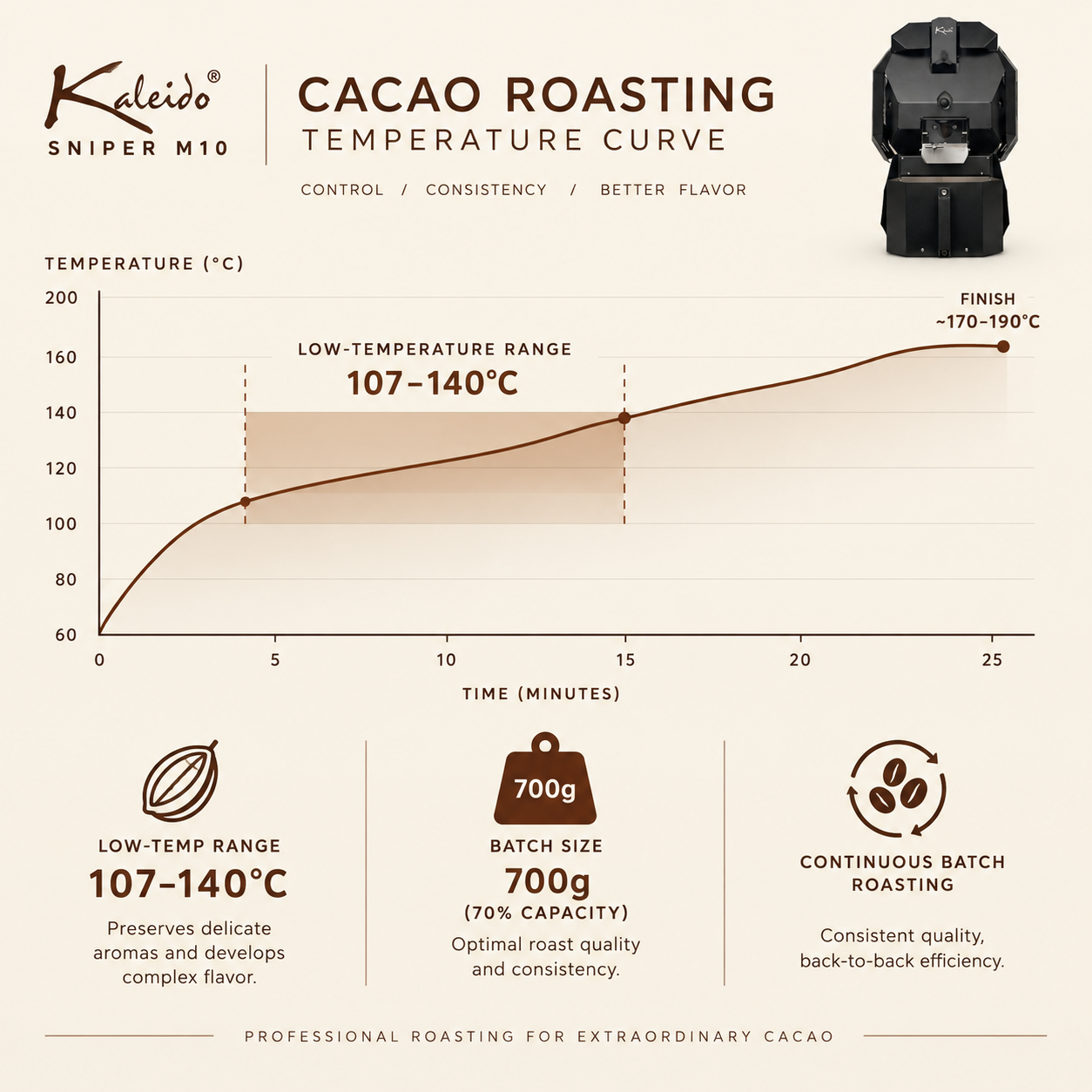
Bottom line up front: The Kaleido Sniper M10 is suitable for roasting cacao beans.
Recommended settings: SV at 140°C, batch size around 70% of machine capacity, and 5–6 back-to-back batches are no problem. The larger size of cacao beans poses no issues for loading, drum rotation, or discharge.
1. Can the M10 Hold Low Roasting Temperatures?
Cacao is typically roasted at much lower temperatures than coffee — roughly 107–140°C (225–285°F). The M10 uses a carbon fiber infrared heating element, and an SV of 140°C is a viable operating setpoint. Infrared heating penetrates well and ramps quickly, so maintaining stable heat output in the low-temperature range is not a concern.
One thing to watch: temperature accuracy depends on probe placement. The M10 features an adjustable-depth self-locking probe seat. For cacao, it’s worth fine-tuning the probe depth based on your actual load size so you’re reading bean-mass temperature rather than ambient temperature.
2. Duty Cycle and Continuous Operation
The M10 can handle more than 10 consecutive batches, so a customer expecting 5–6 back-to-back roasts is well within supported operation.
Real-world user experience supports this — one user completed 8 consecutive 750g batches in about 2 hours, including cooling and cleanup, with only 1–2 minutes of reset time between batches. That said, cacao may cool slightly more slowly than coffee because of its higher density and greater internal heat retention. Take advantage of the M10’s automated cooling system (rated for 2–3 minute rapid cooling) and allow adequate cool-down time between batches.
3. Bean Size and Mechanical Compatibility
Cacao beans are roughly 1″ × 0.5″ — noticeably larger than coffee beans. There are no issues with loading, drum rotation, or discharge.
The M10’s drum is built from 304 stainless steel with a reinforced high-speed steel mesh structure designed to promote even heating and help with husk separation. Cacao bean dimensions won’t cause jamming or poor discharge in this drum configuration. From a product positioning standpoint, the M10 is officially described as capable of handling “coffee beans, nuts, and cacao beans,” which indicates the mechanical design already accounts for non-coffee materials.
4. Recommended Batch Size
A good rule of thumb is to keep batch size at approximately 70% of machine capacity. The M10’s rated capacity is 300–1000g (1200g max), so at 70%:
Recommended cacao batch size: approximately 700g
Customer’s proposed 1kg batch: on the high side, at or near the machine’s limit
Why the 70% guideline? Cacao is more fragile than coffee. Industry experience shows that too thin a batch leaves beans without enough cushioning, making them vulnerable to mechanical damage from the drum vanes; too full a batch prevents proper tumbling and produces uneven heat transfer. Cacao needs gentle tumbling and even thermal contact during roasting, and a 70% load strikes a good balance between bean-bed depth and movement space.
If the customer insists on trying 1kg, the machine can physically handle it, but roast uniformity and bean integrity may suffer. Start at 700g to calibrate your profile, then adjust based on actual results.
5. Practical Summary
Temperature setting: Start at SV 140°C, adjust to taste and origin
Batch size: ~700g (70% capacity); 1kg is the ceiling but not recommended
Continuous operation: 10+ batches supported; 5–6 is no problem
Bean size: No impact; drum and discharge system are compatible
Cooling: Use built-in cooling; allow adequate cool-down between batches
The core difference between cacao and coffee roasting lies in the temperature profile and the physical characteristics of the beans — not in the machine’s fundamental suitability. The M10 offers the temperature flexibility, continuous-operation capability, and drum design needed for cacao roasting. The keys are restraint on batch size and proper probe placement.

0 Comments