
For generations, the global coffee industry has followed a familiar pattern: coffee is grown in producing countries, then shipped away as raw green beans to be roasted, packaged, and sold by businesses in consuming nations. The roasting stage—where the most value is created—has remained almost entirely out of reach for the farmers and communities who grow the crop.
Kaleido Roasters is helping change that. Through a growing global distribution network that now reaches many of the world’s most important coffee-producing countries, Kaleido is putting precision roasting technology directly into the hands of the people at origin. The result is a shift in who benefits from coffee—and a compelling case for why the rest of the industry should pay attention.
The Problem With the Traditional Model
Coffee-producing nations capture only a small fraction of the industry’s total income. In many supply chains, smallholder farmers receive just a few percent of the final retail value of their coffee, while the roasting, branding, and retail stages—all typically located in consuming countries—capture the majority.
The reason is structural. Green coffee is exported as a commodity, and commodities command low prices. The moment those beans are roasted, they become a finished product with far greater margins. For decades, that transformation has happened thousands of miles away from the farm, meaning the wealth generated by roasting has flowed out of the producing country rather than staying in it.
Roasting at origin flips this dynamic. When coffee is roasted where it is grown, the highest-value step in the supply chain stays local. That means more revenue retained in the producing economy, more skilled jobs for local workers, and more bargaining power for farmers who have historically been price takers.
Kaleido’s Role in the Shift
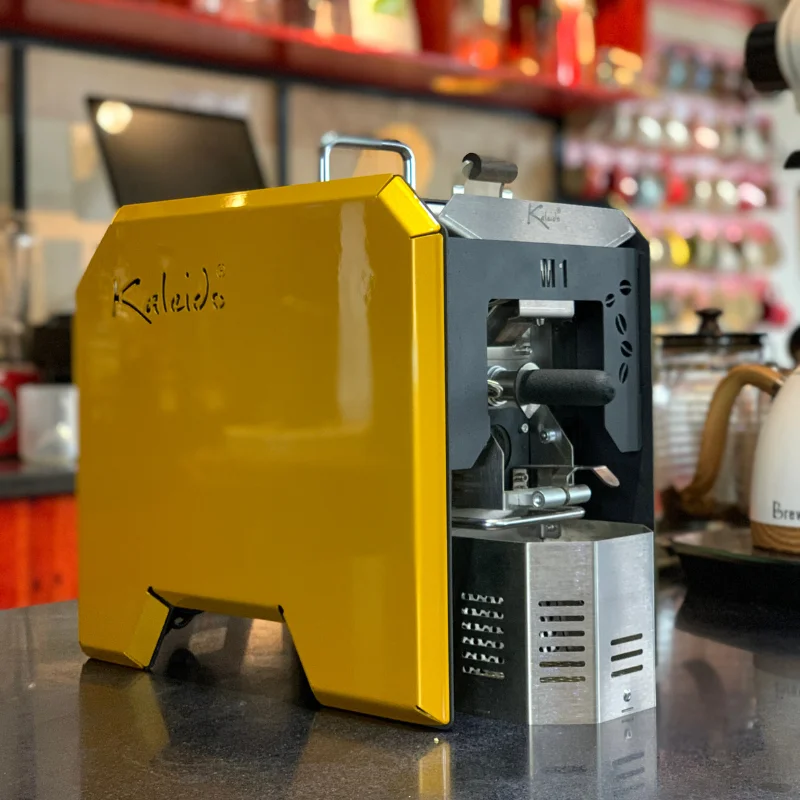
Kaleido Roasters designs and manufactures small-batch electric drum roasters built for precision, consistency, and accessibility. The company’s Sniper series spans a range of capacities—from compact sample roasters to machines capable of supporting small commercial production—with features like carbon fiber infrared heating, tablet-based controls, and compatibility with roasting software.
Crucially, these machines are designed to be practical in the places where coffee is actually grown. They run on standard electrical connections, require no gas infrastructure, and are built for ease of use without sacrificing the control that quality roasting demands. That combination makes them viable for small cooperatives, family farms, and local entrepreneurs who want to roast their own coffee but lack access to industrial-scale equipment.
A Distribution Network Built for Origin
What makes Kaleido’s impact possible is its global distribution network, which now extends into many coffee-producing countries. Kaleido has distributors and authorized partners in Indonesia, Brazil, across East Africa, Colombia, Costa Rica, and many more producing regions. This presence matters enormously.
Technology alone does not empower anyone. A roaster sitting in a warehouse on another continent is of little use to a cooperative that needs spare parts, technical guidance, and support in its own region. By establishing distributors within producing countries, Kaleido ensures that machines, replacement parts, and expertise are accessible where they are needed. Local distributors understand local conditions—humidity, altitude, voltage, and the specific challenges of roasting in tropical climates—and can provide hands-on support that a distant manufacturer never could.
This network turns a piece of equipment into a genuine tool for economic development. A farmer or cooperative that buys a Kaleido roaster is not just buying a machine; they are gaining access to a support system that helps them use it effectively.
The Economic Win
The economics of roasting at origin are straightforward and powerful. When a producing country exports green coffee, it captures a small share of the final value. When it roasts that coffee and sells it as a finished product—whether locally, regionally, or internationally—it captures a dramatically larger share.
That additional value does not disappear into abstract markets. It pays local salaries. It funds small businesses. It supports packaging suppliers, logistics workers, marketers, and technicians. It keeps skilled young people in coffee-growing communities instead of forcing them to migrate in search of opportunity.
For individual farmers and cooperatives, the benefits compound. A group of farmers who can roast and sell their own coffee are no longer purely dependent on the volatile prices offered by distant buyers. They have a product with identity, story, and margin. They can sell directly to consumers, build a brand, and reinvest profits into improving their farms and their communities.
This is not charity. It is a more rational distribution of value—one that recognizes that the people who grow coffee deserve a meaningful role in how it is finished and sold.
Supporting Small Farmers
Smallholder farmers produce the majority of the world’s coffee, yet they are often the most vulnerable actors in the supply chain. They have limited access to capital, limited bargaining power, and limited control over the fate of their crop.
Roasting at origin, enabled by accessible technology and local distribution, gives small farmers a pathway to change that. It allows them to move up the value chain without needing to leave their land or abandon farming. It creates opportunities for cooperatives to pool resources and invest in shared roasting capacity. It opens the door to direct trade relationships where farmers negotiate from a position of strength rather than desperation.
Kaleido’s presence in producing countries across Indonesia, Brazil, East Africa, Colombia, Costa Rica, and beyond is a quiet but meaningful contribution to this shift. Every distributor established in a coffee-growing region is another point of access for farmers who want to take control of their own product.
Why This Matters
The coffee industry has long talked about sustainability, equity, and supporting producers. Roasting at origin is one of the few concrete ways to actually deliver on those promises. It moves money and decision-making power to the places where coffee is grown. It builds local businesses and skilled jobs. It gives farmers a fairer share of the value they create.
Supporting this kind of shift—whether by choosing origin-roasted coffee, backing companies that enable it, or simply recognizing its importance—is a way to participate in a more equitable coffee future. Kaleido Roasters and its distributors in producing countries are proving that the tools exist and the model works. What remains is for the industry and its consumers to recognize that the people closest to the coffee deserve the biggest role in shaping what it becomes.
How Kaleido Roasters Is Empowering Roasting at Origin
Subscribe to our emails
Join our email list for exclusive offers and the latest news.
0 Comments