
Most conversations about Kaleido center on the home enthusiast dialing in a roast curve, or the small café owner pushing the machine to its limits. But a deeper shift is underway in the global coffee supply chain—and Kaleido sits right at its center. The movement is called “roasting at origin,” and its logic is simple: keep the most valuable link in the coffee value chain—roasting—on the soil where the coffee grows.
The Problem with the Traditional Model
For decades, the global coffee industry has followed a fixed path: coffee is grown in producing countries, exported as green beans, then roasted, packaged, and sold in consuming countries. Roasting is where the greatest value is added, yet it happens almost entirely far from the farm.
Producing countries capture only a small fraction of total industry revenue. In many supply chains, smallholder farmers receive just a few percentage points of the final retail price, while roasting, branding, and retail—typically based in consuming countries—take the lion’s share. The reason is structural: green beans are exported as a commodity, and commodities are cheap. Once green beans are roasted, they become a finished product with a very different margin. For decades, that transformation happened thousands of miles away, and the wealth created by roasting flowed out of producing countries rather than staying in them.
Kaleido’s Role
Kaleido designs and builds small-batch electric drum roasters focused on precision, consistency, and accessibility. The Sniper series spans from compact sample roasters to models capable of supporting small-scale commercial production, featuring carbon fiber infrared heating, tablet-based controls, and compatibility with roasting software.
Crucially, these machines are built with the places where coffee is actually grown in mind. They run on standard electrical connections, require no gas infrastructure, and are approachable to operate without sacrificing the control needed for quality roasting. That combination makes them viable for small cooperatives, family farms, and local entrepreneurs—people who want to roast their own coffee but lack access to industrial-scale equipment.
Kaleido’s global distribution network already extends into multiple producing countries. In Indonesia, Brazil, across East Africa, Colombia, Costa Rica, and beyond, Kaleido has distributors and authorized partners. That local presence matters. A roaster sitting in a warehouse on another continent is useless to a cooperative that needs a spare part and technical guidance. By establishing distributors in producing countries, Kaleido ensures machines, replacement parts, and expertise are reachable where they’re needed. Local distributors understand local conditions—humidity, altitude, voltage, and the specific challenges of roasting in tropical climates—and can offer hands-on support that a distant manufacturer never could.
This Is Not a Niche Experiment
Roasting at origin is moving from idea to practice. Los Angeles roaster Go Get Em Tiger has launched a “Roasted at Origin” initiative aiming to shift 20% of its roasting volume to producing countries by the end of 2026, and 70% by the end of 2027. This is not a symbolic gesture but a substantive change to supply chains and workflows. The company develops roast profiles jointly with partners in producing countries, roasts locally, and ships finished coffee back to LA—typically with transit times of 10 to 30 days.
“We believe the people closest to the coffee know it best,” said Geoff Watts, a board member at Go Get Em Tiger. “The people who grow it and manage the meticulous processes behind the quality we value should have a greater say in how the coffee is finished—and more of the work, value, and expertise should stay where the coffee grows.”
The industry conversation is following. World of Coffee New Orleans 2026 dedicated a session to “Roasting at Origin: The Next Frontier in Coffee Manufacturing,” bringing together producers, roasters, engineers, and supply chain innovators to explore how decentralized origin roasting is reshaping the global coffee landscape—including improved roast precision from proximity to processing, reduced carbon footprint, lower logistics costs, and the potential for substantial value retention in producing countries.
The Economics Are Straightforward
When a producing country exports green beans, it captures a small slice of final value. When it roasts locally and sells a finished product—whether locally, regionally, or internationally—it captures a substantially larger share. That additional value doesn’t vanish into an abstract market. It pays local wages, funds small businesses, and supports packaging suppliers, logistics workers, marketers, and technicians. It keeps skilled young people in coffee-growing communities instead of forcing them to migrate in search of opportunity.
For individual farmers and cooperatives, the benefit compounds. A group of farmers who can roast and sell their own coffee are no longer purely dependent on volatile prices offered by distant buyers. They have a product with identity, a story, and margin. They can reach consumers directly, build a brand, and reinvest profits into improving their farms and communities. This isn’t charity—it’s a more rational distribution of value that recognizes the people who grow coffee deserve a meaningful role in finishing and selling it.
Why Kaleido Fits This
The core technical features of the Kaleido Sniper series happen to constitute distinct advantages in producing-country contexts. Carbon fiber infrared heating allows near-instant temperature adjustments—critical in settings where thirty seconds can determine the success of a high-altitude micro-lot. The all-electric system sidesteps the obstacle of gas infrastructure, which in many producing countries is either unreliable or expensive to install. The built-in smoke extraction and compact design let a cooperative or small farm start roasting without industrial-grade ventilation.
And Artisan compatibility with profile replication means a cooperative in Colombia can record the perfect roast curve for a specific lot and reproduce it precisely. This isn’t a home hobbyist’s toy relocated to a farm; it’s professional-grade repeatability placed in the hands of origin.
The Question for the Industry
Kaleido’s machines won’t change supply chains by themselves. What changes supply chains is the people using them—the cooperatives and farmers who decide to stop selling only green beans and take the roasting step into their own hands. Kaleido’s role is to make that decision technically and economically feasible.
If you’re roasting at origin, or you know someone who is, we want to hear your story. Which model are you running? What challenges have you faced with humidity and voltage? How do your roast curves differ from those of peers in consuming countries? These experiences deserve to be shared, because for origin roasting to become a movement rather than a scattering of experiments, it needs exactly this kind of practical knowledge from the source.
The coffee industry has talked about sustainability and producer empowerment for years. Roasting at origin offers a concrete path: not through certification labels or aid programs, but by keeping the most valuable link in the value chain where it belongs. Kaleido didn’t start this movement, but its machines are making it practically meaningful for more people.
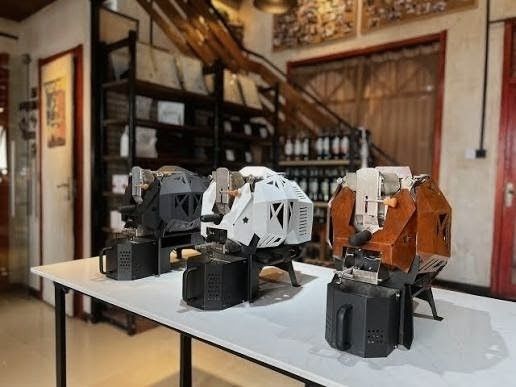
How Kaleido Roasters Are Quietly Powering the “Roast at Origin” Revolution
Subscribe to our emails
Join our email list for exclusive offers and the latest news.
[contact-form-7 id="eaf88b5" title="footer subscribe"]
0 Comments