
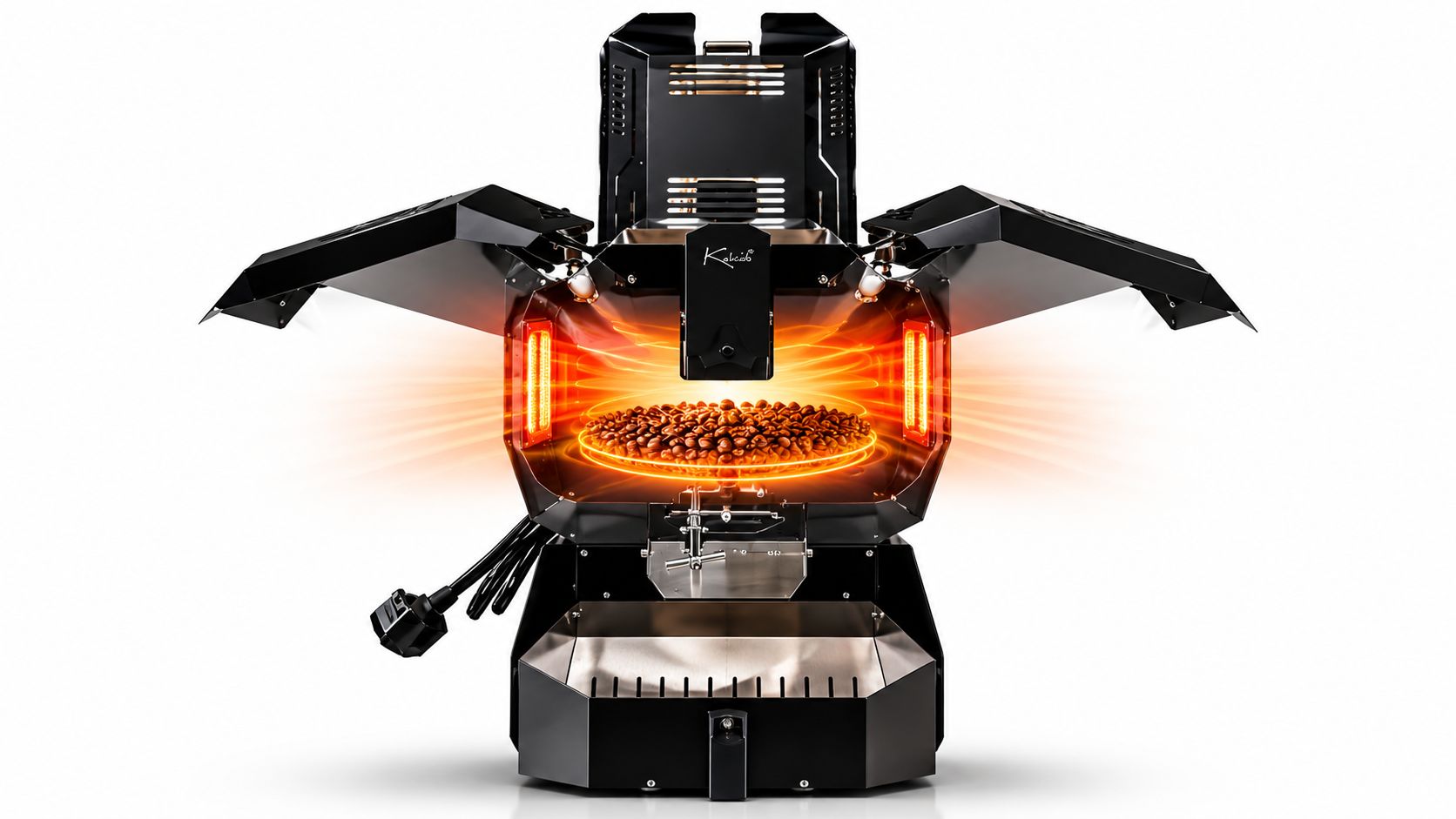
Most home coffee roasters still work on a principle that hasn’t changed much in a century: heat a metal drum, tumble beans against it, and hope the conduction doesn’t scorch the batch. Kaleido Roasters takes a different path—one built on carbon fiber, infrared heat, and a sealed negative-pressure system. Here’s why that engineering matters, and what it actually does to your roast.
The Problem With Traditional Drums
Conventional drum roasters rely primarily on conduction—beans physically touching hot metal. That works, but it’s imprecise. Hot spots form, chaff sticks to the drum, and the difference between “developed” and “scorched” can be a matter of seconds. Air-flow roasters (fluid bed) solve the scorching problem but often produce a thinner, less textured cup.
Kaleido’s design sits in a deliberate middle ground.
How the Infrared System Works
At the core of Kaleido’s approach is a carbon fiber infrared heating element that radiates heat directly onto a perforated stainless steel drum. Instead of waiting for a thick metal mass to heat up and transfer energy by contact, infrared energy penetrates the bean surface more evenly and responds faster to controller input.
The result is rapid, precise heat response—you can make meaningful adjustments mid-roast without the lag that plagues heavy cast-iron drums.
The Sealed Negative-Pressure Design
This is the part that separates Kaleido from most competitors. The roasting chamber operates under negative pressure, meaning air is drawn through the system rather than pushed out. Combined with a sealed drum design, this creates a hybrid environment:
Direct infrared radiation heats the beans
Hot air circulation moves through the perforated drum
Smoke and chaff are evacuated efficiently rather than recirculating
The practical effect is a cleaner flavor profile—less smokiness, less taint from chaff—while retaining the body and texture that drum-roasting purists insist on.
Why This Beats the Alternatives
Heat transfer: Traditional drum is conduction-heavy; fluid bed is convection-only; Kaleido uses an infrared + convection hybrid.
Response time: Traditional drum is slow due to thermal mass; fluid bed is fast; Kaleido is fast.
Scorch risk: Traditional drum is moderate–high; fluid bed is low; Kaleido is low.
Body/texture: Traditional drum gives full body; fluid bed gives lighter body; Kaleido gives full body.
Chaff handling: Traditional drum is manual and messy; fluid bed has it built-in; Kaleido uses sealed evacuation.
What It Means for the Home Roaster
The engineering translates into something simple: repeatability. Infrared heat responds quickly to profile changes, the sealed system keeps the environment stable, and the negative pressure means you’re not fighting smoke in your garage. For someone chasing consistency batch after batch—or trying to replicate a profile from a friend—that stability is the whole game.
Kaleido isn’t the cheapest way into roasting. But if the goal is pro-level control in a home-sized package, the infrared-plus-sealed-drum approach is a genuinely different answer to an old problem—and one worth understanding before you buy anything with a heating element and a bean chute.
0 Comments