
For decades, the specialty coffee industry was defined by a massive barrier to entry. If you wanted to roast your own coffee, you needed high-pressure gas lines, industrial ventilation, and a five-figure investment just to get a drum spinning.
In 2026, that blueprint has been rewritten. At Kaleido Roasters, we are seeing a global shift toward the “Microroastery” model. Whether you are a cafe owner looking to reclaim your margins or a coffee professional launching a boutique brand from a studio, the Kaleido Sniper series has become the catalyst for this movement.
Here is how infrared technology and integrated smart systems are redefining the business of roasting for the modern entrepreneur.
1. The Precision of “Sniper” Technology
The name isn’t just marketing—it’s a description of intent. Traditional roasting relies heavily on thermal mass, heating a heavy metal drum and using that stored heat to cook the beans. While effective, it’s slow to react, making it difficult to “pivot” mid-roast.
The Kaleido Sniper utilizes carbon-fiber infrared direct-fire heating. This allows for near-instantaneous temperature adjustments. If your “Rate of Rise” (RoR) is peaking too early, a flick of the dial results in an immediate response. This level of surgical control is vital when roasting expensive, high-altitude microlots where thirty seconds can be the difference between a “floral masterpiece” and a “baked flat” batch.
2. The “Smart” Advantage: Professional Data, Integrated
One of the biggest misconceptions about modern micro-roasters is that you need a mess of cables and a dedicated laptop to achieve consistency. The Kaleido Sniper’s Standard/System changes that narrative entirely.
The built-in tablet is a sophisticated roasting computer. Right out of the box, it allows you to:
Real-Time Logging: Track your bean temperature (BT), environmental temperature (ET), and RoR in high-definition as the roast happens.
Deep Analysis: After the “drop,” you can overlay previous roast curves to see exactly where your heat application differed, allowing you to diagnose your flavor profiles instantly.
Precision Replication: Once you find that “God Shot” roast for a specific origin, you can save the profile. The tablet’s automation can then take over, controlling the infrared power and fan speed to mirror that exact curve for your next batch.
For a busy cafe, this means a simplified, professional workflow without the need for external software or extra counter space.
3. Solving the “Urban Roasting” Problem
Most cafes are located in urban centers where gas permits and external venting are either impossible or prohibitively expensive. Because the Sniper is a pure-electric system, it circumvents the need for gas infrastructure entirely.
Furthermore, the design utilizes a negative-pressure chamber and built-in smoke extraction. While you still need basic ventilation, the “environmental footprint” of a Sniper is a fraction of a traditional gas roaster. This allows businesses to roast in-house, filling the street with the aroma of fresh coffee rather than the sound of industrial exhaust fans.
4. The Bottom Line: ROI and Brand Equity
Roasting in-house typically reduces your green-to-roasted coffee cost by 30% to 50%. For a cafe serving 40–50 lbs of coffee a week, a Kaleido M10 (1.2kg capacity) can pay for itself in less than a year.
Beyond the savings, you are building Brand Equity. When you aren’t just a “coffee shop” but a “roastery,” you become a destination. You control the freshness, you control the story, and you control the profit. At Kaleido Roasters, we aren’t just shipping machines; we’re helping you build the future of your coffee business.
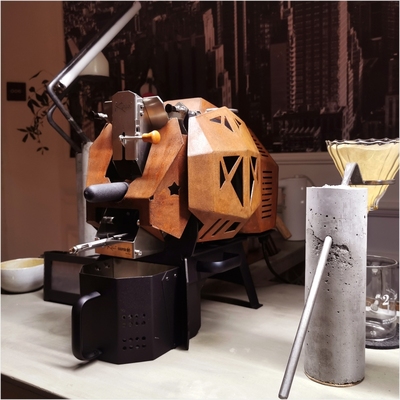
The Microroastery Revolution: Precision, Profit, and the Power of Infrared
Subscribe to our emails
Join our email list for exclusive offers and the latest news.
0 Comments