
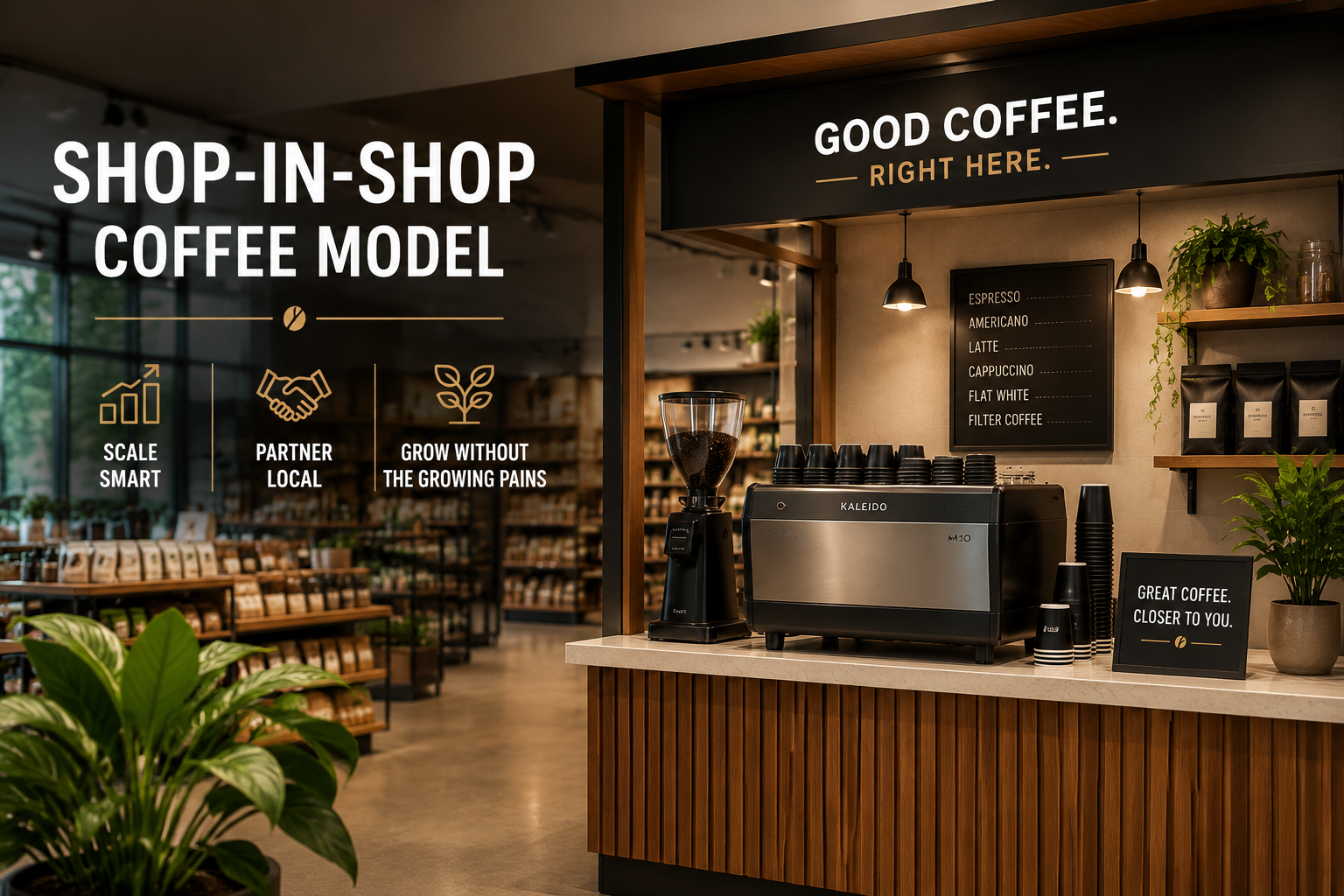
The shop-in-shop model is transforming how coffee reaches customers, turning convenience stores, gas stations, internet cafes, and pharmacies into profitable coffee destinations. A shop-in-shop — sometimes called a “store-within-a-store” — embeds a coffee brand’s operation inside an existing business. The host provides the space and staff, while the coffee company supplies materials and equipment. The host earns incremental revenue from coffee sales, and the coffee brand profits from ingredient margins.
This model opens new pathways for small businesses and roasters worldwide. Here’s how to make it work.
The Shop-in-Shop Opportunity
The numbers speak for themselves: Nowwa Coffee — built on shop-in-shop — grew from 1,200 to 10,000 stores in a single year by partnering with over 100 convenience store chains. During one strategic partnership, they generated over $1 million USD in revenue while partner stores saw revenue increases of 20% to 50%, with some locations boosting customer traffic by 35% and ticket sizes by nearly 30%.
In 2026 alone, coffee brands have partnered with pharmacies, gas stations, fitness chains, and snack shops — proving this model works across nearly any retail environment.
Why This Model Works — For Everyone
For small business owners, the appeal is obvious. You don’t pay for expensive new equipment or hire extra staff because your existing team can be trained to brew coffee. At one chain, the monthly rent paid by the coffee brand to host stores was “very low, almost negligible.” Meanwhile, the coffee brand handles everything from supply chain to brand marketing.
How Coffee Roasters Benefit Most
Coffee roasters who embrace this model unlock new opportunities:
· Secure a stable wholesale base — Each host location becomes a reliable revenue stream.
· Dramatically reduce per-unit costs — Roasting in-house cuts green-to-roasted costs by 30–50% compared to buying from wholesale roasters.
· Build brand visibility — Every shop-in-shop location showcases your coffee, driving recognition and loyalty.
· Differentiate from competitors — Smaller roasters use this model to compete with giant chains through nimble, creative partnerships.
· Scale without massive debt — Shop-in-shops require minimal upfront investment, letting you expand using partners’ infrastructure.
Your Startup Roadmap
Step 1: Find Your First Partner — Look for complementary businesses where your customers naturally spend time. Petrol stations attract commuters; bike shops attract fitness-focused customers who linger.
Step 2: Keep It Simple — Start with a limited menu of high-quality brews and simple preparation methods. Your host’s staff aren’t professional baristas, so easy-to-follow workflows matter.
Step 3: Own the Supply Chain — Provide consistent beans, training materials, and equipment support. Your reliability becomes your competitive advantage. With a compact roaster like the Kaleido Sniper series, you can roast fresh beans just-in-time for your shop-in-shop locations.
Step 4: Track Performance Closely — Monitor sales, staff efficiency, and customer feedback at each location. The best performers will guide your expansion.
Step 5: Build Systems That Scale — As you grow, standardized training, automated ordering, and quality control become essential. Invest in tools that make it easy to replicate successful partnerships.
The Challenges — and How to Overcome Them
Quality Consistency — Since host staff typically run the operation, quality can vary. Solution: Create simple visual guides, schedule regular quality checks, and develop relationship-focused training for your partners.
Limited Product Offerings — Small corner spaces restrict what you can sell. Solution: Focus on a core menu of 2–4 coffee options that sell fastest. Quality over quantity wins.
Brand Dilution — Your presentation may not match your flagship locations. Solution: Use branded signage, packaging, and even small roaster displays (like the Kaleido Sniper’s interactive roasting bar) to make every shop-in-shop feel authentic.
The shop-in-shop model is not about replacing your coffee shop. It’s about multiplying your reach without multiplying your overhead. For roasters and entrepreneurs willing to build smart partnerships, the path has never been clearer — or more profitable.
0 Comments