
For the home roasters, small cafés, and origin producers that Kaleido Roasters serves, the specialty coffee industry in 2027 presents a contradictory picture: the demand-side growth story remains intact, but supply-side cost and climate pressures are reshaping the power structure of the entire value chain. Understanding the logic of this year is essential for anyone who depends on green coffee sourcing, roast quality, and consumer trust.
Demand Side: Specialty Coffee Has Shifted from “Occasional Treat” to “Daily Habit”
The market foundation for specialty coffee is firmer in 2027 than ever before. In the United States, specialty coffee consumption has surpassed traditional coffee—2026 data showed that 47% of American adults had consumed specialty coffee in the past day, compared with 42% for traditional coffee. This means specialty coffee is no longer a niche category that needs to be “educated” into existence. It has become part of mainstream consumer behavior.
For equipment manufacturers like Kaleido, the significance is clear: the demand base for home roasting and small-batch roasting is expanding. When consumers grow accustomed to café-level quality, they naturally ask the next question—can I achieve the same standard myself? The reason machines like the M2 Lite, with its 200–500 g capacity, drew attention at World of Coffee Bangkok 2026 is precisely that it responds to this group of advanced users who refuse to compromise but have limited space. In 2027, this demand will only become more specific: consumers are no longer satisfied with “being able to roast”—they demand the ability to roast precisely and roast reproducibly.
Supply Side: Climate Risk Is Rewriting the Sourcing Logic of Specialty Coffee
The most unavoidable variable for 2027 comes from the supply side. In 2025, some farms in Brazil’s Cerrado Mineiro region experienced yield losses of up to 44% due to high temperatures and abnormal precipitation, and the reverberations of that shock will continue to affect green coffee prices and availability through 2027. The structural dilemma facing specialty coffee roasters is this: they depend on specific estates, specific lots, and specific processing methods—not on commodities that can be swapped at will. When a favored lot is reduced in volume or inconsistent in quality due to climate factors, roasters cannot simply “switch to another origin” without affecting product consistency.
The implication for Kaleido’s user base is twofold. On one hand, the value of origin roasting will become more pronounced in 2027. As cross-border supply chain risks and costs rise simultaneously, completing the roast at origin and exporting a finished product not only retains more value in the producing country but also reduces the carbon footprint and quality loss associated with green coffee transport. Kaleido’s distribution networks in Indonesia, Brazil, East Africa, Colombia, and Costa Rica are making this model technically feasible and economically rational.
On the other hand, rising green coffee costs mean the margin for error in roasting is narrowing. Every batch ruined in 2027 costs more than it did three years ago. This is where the practical value of Artisan software compatibility in Kaleido’s product philosophy becomes concrete: recording curves, reviewing curves, and replicating curves allows roasters to stabilize output by adjusting roast strategy when green coffee quality fluctuates—rather than relying on luck.
Price and Affordability: The “Value Communication” Test for Specialty Coffee
In January 2025, coffee prices remained at historically high levels, with the International Coffee Organization reporting an average price of approximately $2.67 per pound. By 2027, price pressure has not fundamentally eased. For specialty coffee roasters, this means a difficult balance: you cannot absorb all cost increases without damaging margins, but over-passing costs to consumers risks triggering “trading down.”
Industry research offers clear guidance: businesses need to be more creative in product mix, packaging, and communication—conveying value to consumers rather than merely conveying price. For the micro-roasters and small cafés that Kaleido serves, this is precisely their advantage—they can speak directly with customers, telling the story of a bean’s origin, the uniqueness of its processing method, and the design intent behind a roast curve. A machine capable of precisely recording and sharing roast curves is not just a production tool here; it is a vehicle for value communication.
Technology Trends: Convenience and Professionalism in Parallel
The specialty coffee market is diversifying internally. The fastest-growing product format is coffee capsules and pods, projected to achieve a compound annual growth rate of 7.65% between 2026 and 2031. This may appear to contradict the “hand-roasting” spirit that Kaleido represents, but it actually reflects two facets of the same underlying demand: consumers want both convenience and quality. The rise of pods demonstrates that in convenience scenarios, people are unwilling to return to the quality level of instant coffee.
Kaleido targets a different scenario: when consumers are willing to invest time and attention, they need tools that do not compromise. The M2 Lite’s 1–100 stepless adjustment, dual temperature probes, and carbon fiber infrared heating system exist to enable a home roaster to produce output approaching professional workshop standards in their own kitchen. In 2027, these two scenarios will not replace each other—they will continue to develop in parallel, serving the same consumers in different moments of their lives.
Regulation and Compliance: The Underestimated Competitive Barrier
The implementation timeline of the EU Deforestation Regulation (EUDR) was delayed in 2025, but its long-term direction is irreversible. For large importers, compliance means a comprehensive upgrade of supply chain traceability systems; for small roasters, compliance means that their importers or green coffee suppliers must be able to provide complete origin documentation and due diligence files. In 2027, suppliers who can provide traceable, compliant green coffee will command a premium, while channels unable to meet the requirements will be gradually squeezed out of the specialty coffee supply chain.
Kaleido’s progress on certification is worth noting. In November 2026, the Kaleido Sniper series obtained EU CE certification, covering the Low Voltage Directive and Electromagnetic Compatibility Directive. Meanwhile, Kaleido Roasters Canada is leading the SGS North American certification process, covering the full M1 through M10 series. SGS is an OSHA-recognized National Recognized Testing Laboratory (NRTL) in the United States, and this certification has substantive significance for equipment procurement in commercial settings—insurance providers, health and safety inspections, and commercial kitchen compliance reviews may all require equipment bearing the corresponding certification mark. For users planning to upgrade their roasting operation from “side business” to “formal commercial entity” in 2027, equipment compliance is becoming a factor that must be factored in ahead of time.
The Survival Rules for 2027
Taken together, the winners in the 2027 specialty coffee industry will not be the players pursuing the largest scale or the lowest price. Industry research repeatedly points to the same conclusion: the tension between high prices and affordability will be resolved through “value communication”; climate risk will be hedged through “supply chain resilience”; regulatory costs will be absorbed through “traceability systems.”
For the community Kaleido serves—home roasters, small cafés, and origin producers—these macro trends are not abstract. They manifest concretely as: the purchase price of the next batch of green coffee, the mistakes to avoid in the next roast, and the value that needs to be communicated to the next customer. The role of a precise, reliable, and reproducible roasting machine in this environment is clear: it cannot solve climate problems or price problems for you, but it can ensure that at every controllable step, you do not waste increasingly expensive green coffee or miss increasingly discerning customers.
2027 will not be an easy year. But for those who treat roasting as a craft rather than an accessory to business, it remains a year worth taking seriously.
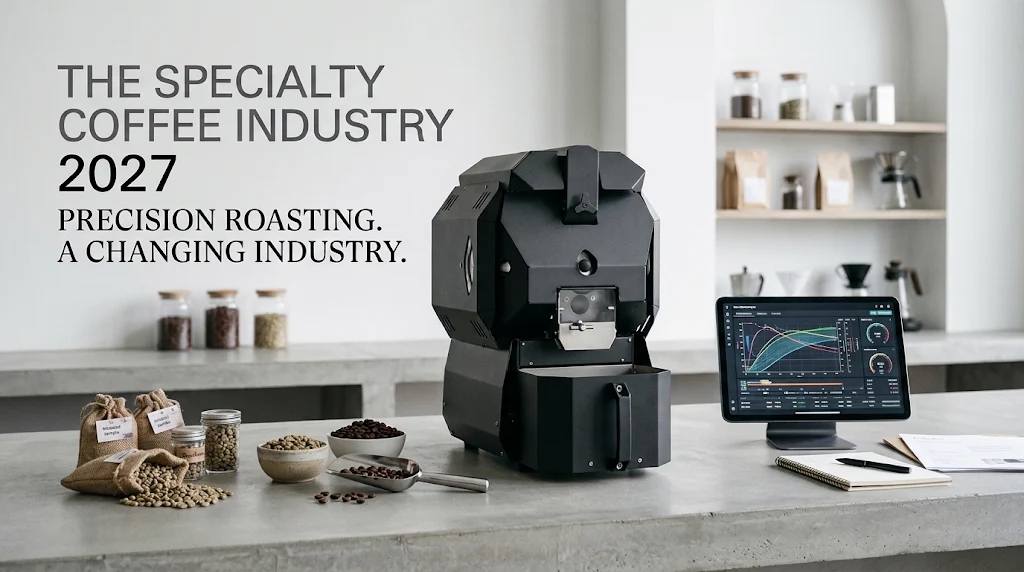
The Specialty Coffee Industry in 2027: A Precision Roasting Perspective
Subscribe to our emails
Join our email list for exclusive offers and the latest news.
[contact-form-7 id="eaf88b5" title="footer subscribe"]
0 Comments